





By Chris Schad -
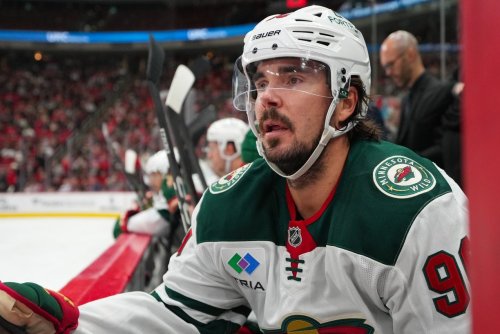
Last spring, the Minnesota Wild may have had their best chance to advance past the first round of the playoffs for the first time since 2014-15. The Wild seized momentum early in the series, jumping out to a 2-1 lead. While they lost three straight games to book their early tee times, there were several positive developments to take from it, including Marcus Foligno's play.
Foligno was a wrecking ball during that playoff series, scoring three goals and an assist. He was a physical presence that temporarily threw the Golden Knights off their game. He made it feel like this was a different Wild team, if only for three games.
After turning 34 last August, Foligno’s performance was always going to be a year-to-year thing. However, few saw the decline he’s experienced this season.
Entering Thursday’s game against the Seattle Kraken, Foligno had just two goal and six points through his first 37 games. His minus-9 rating is tied for the worst on the team with Zeev Buium, who the Wild traded in the Quinn Hughes deal, and it doesn’t feel like Minnesota is getting the value out of his $4 million AAV contract.
So what happened to Foligno? And can the Wild get him back in time for the second half? It’s a storyline that could play a key role in how this year’s team pans out.
Foligno signed a four-year, $16 million contract extension before the 2023-24 season, and the price tag may have raised some eyebrows. He had posted a career year during the 2021-22 campaign, scoring 23 goals and recording 42 points. However, it came with the caveat of a league-leading 23.5% shooting percentage.
That percentage should have been a warning. Foligno crashed back to earth the following year, scoring seven goals, recording 21 points, and posting a 8.4% shooting percentage over 65 games. But general manager Bill Guerin pulled the trigger anyway, extending him into his mid-30s.
There were two reasons for this. The first is that Guerin doesn’t mind the price tag if it brings intangibles to the team. While Foligno is best suited as a bottom-six player, Guerin covets his leadership and presence in the locker room. In his mind, paying a little more or giving a no-movement clause is better than not having the player at all, which explains why Foligno is still in Minnesota.
But the other is that Foligno is one of the NHL's best defensive forwards. Evolving Hockey’s player card shows the difference between both sides of Foligno’s game. While he’s ranked in the seventh percentile of offensive production, he’s still in the 89th percentile defensively.
At this point, the Wild may need to take the good with the bad. But while the defense has done wonders for Filip Gustavsson and Jesper Wallstedt, the offense has become a significant issue for the bottom six. Basically, if top guys like Matt Boldy and Kirill Kaprizov aren’t scoring, the Wild typically aren't scoring enough goals to keep up with top-tier teams like the Dallas Stars and the Colorado Avalanche, especially during a seven-game series.
It's also possible that injuries are having a cumulative effect on Foligno, who led the Wild with 253 hits last season. He could also just be hitting the age cliff, which many believed would happen as he entered the midpoint of his contract. It also paints a grim picture. The Wild may have an untradeable asset in the bottom six. Still, it could also be that Foligno knows when to turn it on.
That’s why his performance in last year’s playoffs is an important data point. The statistical production was a nice surprise, but few were blown away by how physical Foligno was in that series. With the Wild virtually locked into a playoff spot, Foligno could be biding his time and knowing that the final stretch of the regular season and the playoffs are the time to turn it on.
But it becomes a bigger problem when the Wild needs production from its bottom six immediately. Ryan Hartman has done his part with 12 goals and 19 points over 43 games. Still, the rest of the group has been unproductive, with Yakov Trenin scoring three goals with 14 points over 46 games and Vinnie Hinostroza scoring three times with seven points and a minus-5 rating in 32 games this season.
It’s also something that could be fixed at the trade deadline. While Foligno is unlikely to be moved, a trade for an offensively gifted bottom-six forward could breathe life into the group. That could put Foligno in more advantageous situations and help him provide enough offense to raise his overall value.
If Foligno can find his previous form, he could be a physical force that adds just enough offense to help Minnesota get over the top. If he can’t, it invites long-term questions about the final two years of his contract and could also send the Wild to another first-round exit.
Think you could write a story like this? Hockey Wilderness wants you to develop your voice, find an audience, and we'll pay you to do it. Just fill out this form.




Recommended Comments
Join the conversation
You can post now and register later. If you have an account, sign in now to post with your account.
Note: Your post will require moderator approval before it will be visible.