




By Justin Hein -
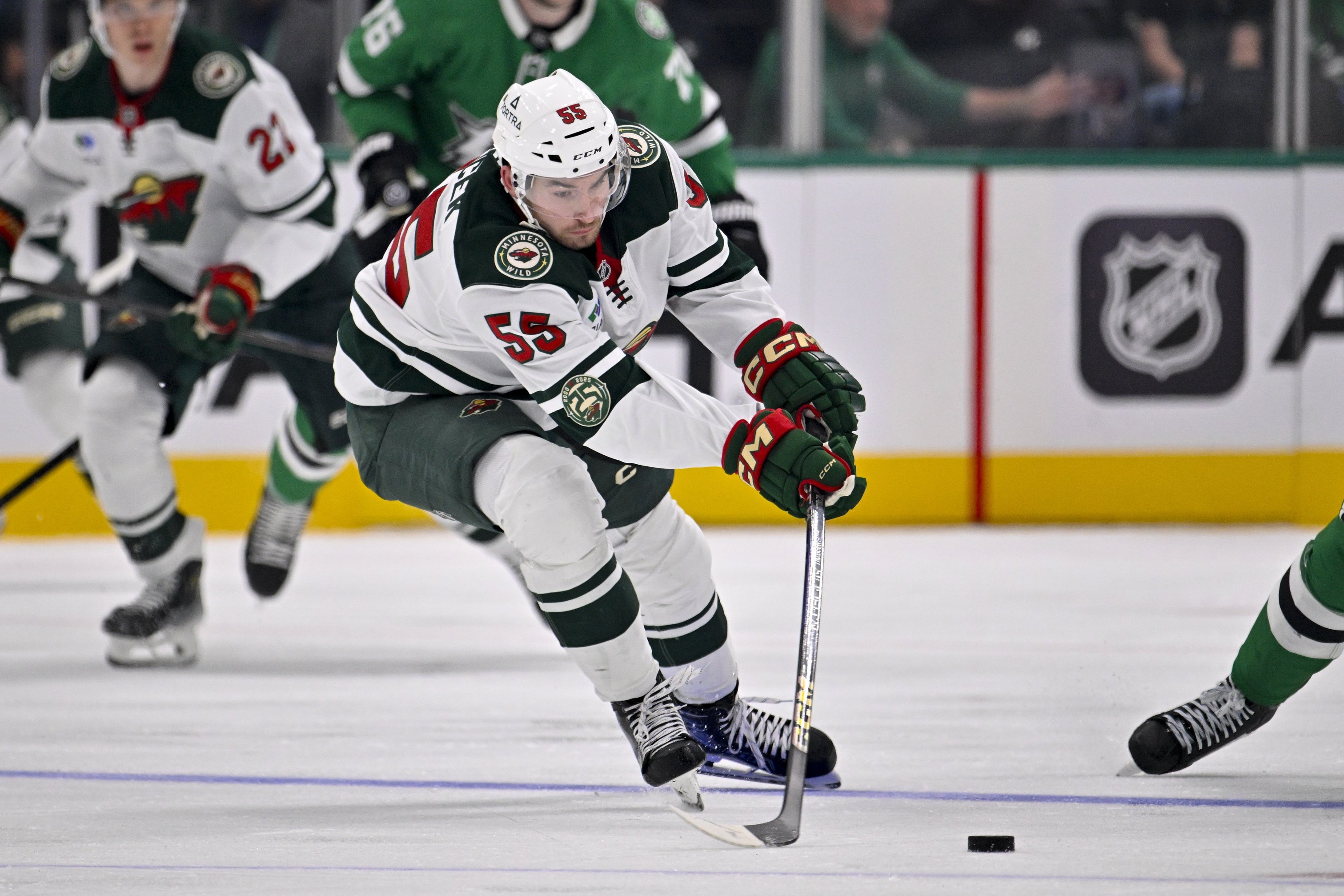
David Jiricek has turned from an exciting prospect into what Midwesterners politely call “interesting.”
Well, that's not quite fair. Minnesota-"interesting" usually translates to awful, I hate it, never show me this again, please. Jiricek is more of a mix of confusing and polarizing. That's legitimately interesting.
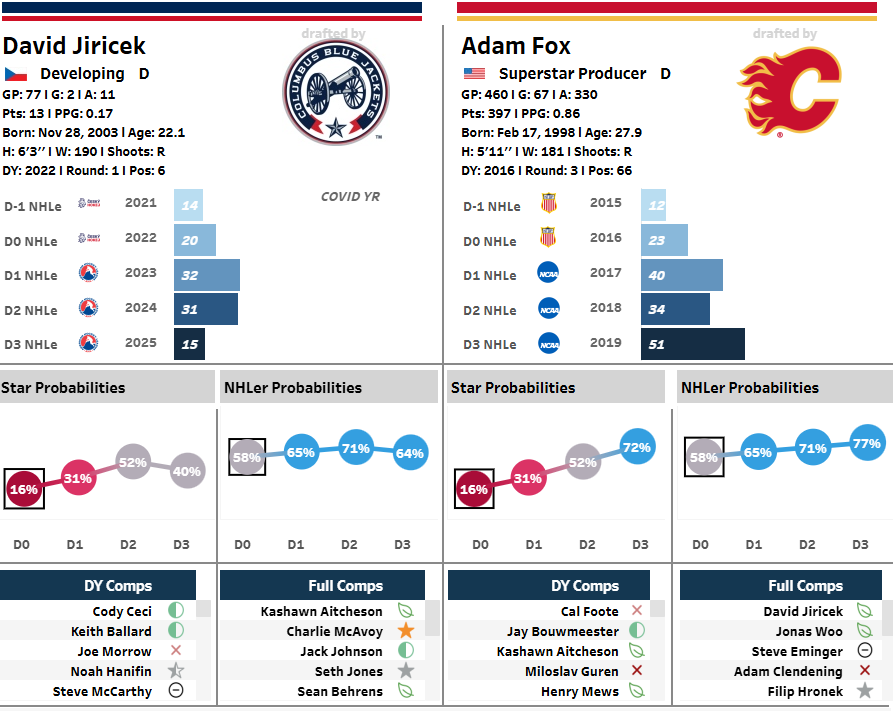
Only four years ago, he was a sixth-overall pick with incredible tools and offensive production to match it. Two years after that, Jiricek had progressed from the top professional league in Czechia to the AHL. He was producing an NHL equivalency (NHLe, a metric that translates scoring from minor leagues based on the difficulty of scoring) of about 30 points per 82 games.
Then, in November 2024, Minnesota traded Daemon Hunt and four draft picks to the Columbus Blue Jackets to acquire Jiricek.
This was supposed to be an opportunity for an ascending player to join an ascending organization. Instead, Jiricek’s production plummeted. In 2024-25, the Czech defender played only 6 games for Minnesota, averaging 13:02 per game.
It’s not surprising that his NHL role was diminished from the 43 games and 14:36 per game he played on Columbus’s NHL team the year prior; the Blue Jackets finished near the bottom of the league standings in 2023-24, which meant they had plenty of meaningless games and minutes to feed their prospects at the end of the season.
More concerning, however, is that Jiricek’s AHL production dropped drastically -- from 31 NHLe to 15 in Iowa. This is a per-game statistic, so the time he spent on the bench before the trade wasn’t a factor.
On March 22, things went from bad to worse. Jiricek discovered an injury that would soon take him off the ice for the remainder of the season.
Obviously, no injury is helpful, but it can be especially difficult for developing prospects. The Athletic’s Joe Smith reported that it took three to four weeks to resume running, and that Jiricek wasn’t able to participate in one-on-one battle drills during the summer of 2025. Jiricek called it “the toughest season for me in the U.S.”
All that seemed to be behind him, until he was conspicuously left off the Czech Olympic roster. Not only that, but fellow Wild prospect David Spacek made the team.
Spacek and Jiricek were in the same draft class, but Spacek was a fifth-round pick, selected 147 players after Jiricek.
How is it possible that just four years later, only one of them is an Olympian -- and it’s not the 6’4” demigod?
What’s especially strange about team Czechia’s preference for Spacek is that Minnesota has favored Jiricek for NHL callups. Jiricek has played 18 NHL games this year, while Spacek is yet to make his debut.
That doesn’t necessarily mean that one of Team Czechia or Minnesota is wrong about the two players. It could be that Jiricek is a better fit for NHL hockey, while Spacek is more trustworthy in a best-on-best environment.
Jiricek has shown a tendency in the NHL to turn the puck over in his defensive zone, which can be disastrous quickly if it comes against a line featuring Connor McDavid, Sidney Crosby, and Nathan MacKinnon.
That’s a pretty thin line to walk. In most cases, a better hockey player is better at all levels, not specifically against certain levels of competition.
More likely, Spacek may be a better fit for Czechia’s aspirations for these Olympics. That could be for a few reasons.
Perhaps Spacek really is a better player right now. Perhaps Jiricek has only played in front of Spacek in the interest of Jiricek’s development. After all, Minnesota gave up a horde of draft picks to acquire Jiricek. On the other hand, the Olympics are once every four years. Czechia has little to gain from rostering players who won’t help it in the future.
Another possibility is that Spacek’s talents fit Czechia’s system better than Jiricek’s. It’s not hard to imagine that the Czechs hope to keep games close as heavy underdogs (14-to-1 odds for a gold medal, compared to the USA around two-to-one and Canada at +135). Blocking shots and counterattacking are common strategies to that end, and Jiricek’s booming slapshot won’t factor into a plan like that.
Finally, it could be that Jiricek’s unsteady performance at the NHL level has Czechia skittish. While Spacek might currently be a less effective player, it’s hard to be sure since he hasn’t yet played. That’s a knock on Spacek in and of itself, but Jiricek’s ugly turnovers are likely to become a factor at the Olympic level.
Jiricek’s skill set might be better suited to medaling, but it’s just not realistic for Czechia to expect that in a tournament already featuring the USA, Canada, and Sweden. If Czechia’s goals are more modest -- perhaps focused on beating lesser teams in the group stage and securing a better record overall -- Spacek’s inclusion over Jiricek makes more sense.
It’s possible that Czechia is flat-out wrong to leave Jiricek off its Olympic roster. At age 20, Jiricek’s impacts in The Athletic’s analytical model looked like a bottom-pair quality defenseman. That season, he took on minutes befitting a second-pair defenseman and came out with impacts similar to Zach Bogosian’s 2023-24 performance.
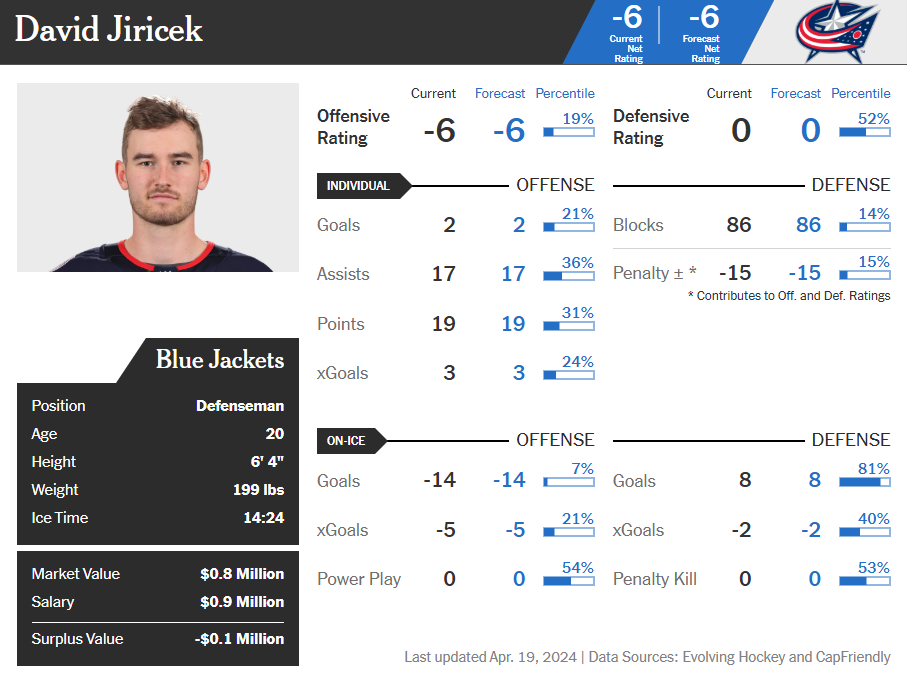
Two years of development later, though, and it’s difficult for Wild fans to argue they see a better player on the ice.
The Jiricek acquisition may be simply a colossal whiff by Bill Guerin. If it is, he’s earned it. In his tenure, he’s acquired Brock Faber via trade, Zeev Buium via the draft, and Declan Chisholm via waivers.
He also extended Jared Spurgeon and Jonas Brodin, then protected the later years of those contracts by acquiring Quinn Hughes to take over the top pair from them. Jake Middleton, Jon Merrill, and Zach Bogosian have been efficient and creative signings to cover the bottom pair and play higher in a pinch.
Calen Addison busted out. If Jiricek is the only other true miss, that’s part of the process to build an exceptional defense corps.
Before writing the towering blue-liner off, though, remember that development is not linear. It’s not a matter of getting one percent better every day; rather, players grind and develop individual skills such as shooting, skating, and (crucially for Jiricek) decision-making. Each of these skills can influence the others, which leads to a cycle of plateaus and breakthroughs.
Nobody knows for sure how good David Jiricek will become. Someday, his story will become a lesson in what to look for (or avoid) in the NHL draft. For now, let him serve as a reminder that the development process often comes with frustration.
Just don’t confuse frustration with the absence of progress.
Think you could write a story like this? Hockey Wilderness wants you to develop your voice, find an audience, and we'll pay you to do it. Just fill out this form.
-
 2
2
.thumb.jpg.acd5dedd7251543624c6b47bfa6a1212.jpg)



Recommended Comments
Join the conversation
You can post now and register later. If you have an account, sign in now to post with your account.
Note: Your post will require moderator approval before it will be visible.