




By Robert Brent -
While the dust is still settling on the Quinn Hughes blockbuster trade, the Minnesota Wild likely still has business to conduct. The Central Division is an arms race this season, and the Wild has some deficiencies to shore up. The main area they can improve is at center.
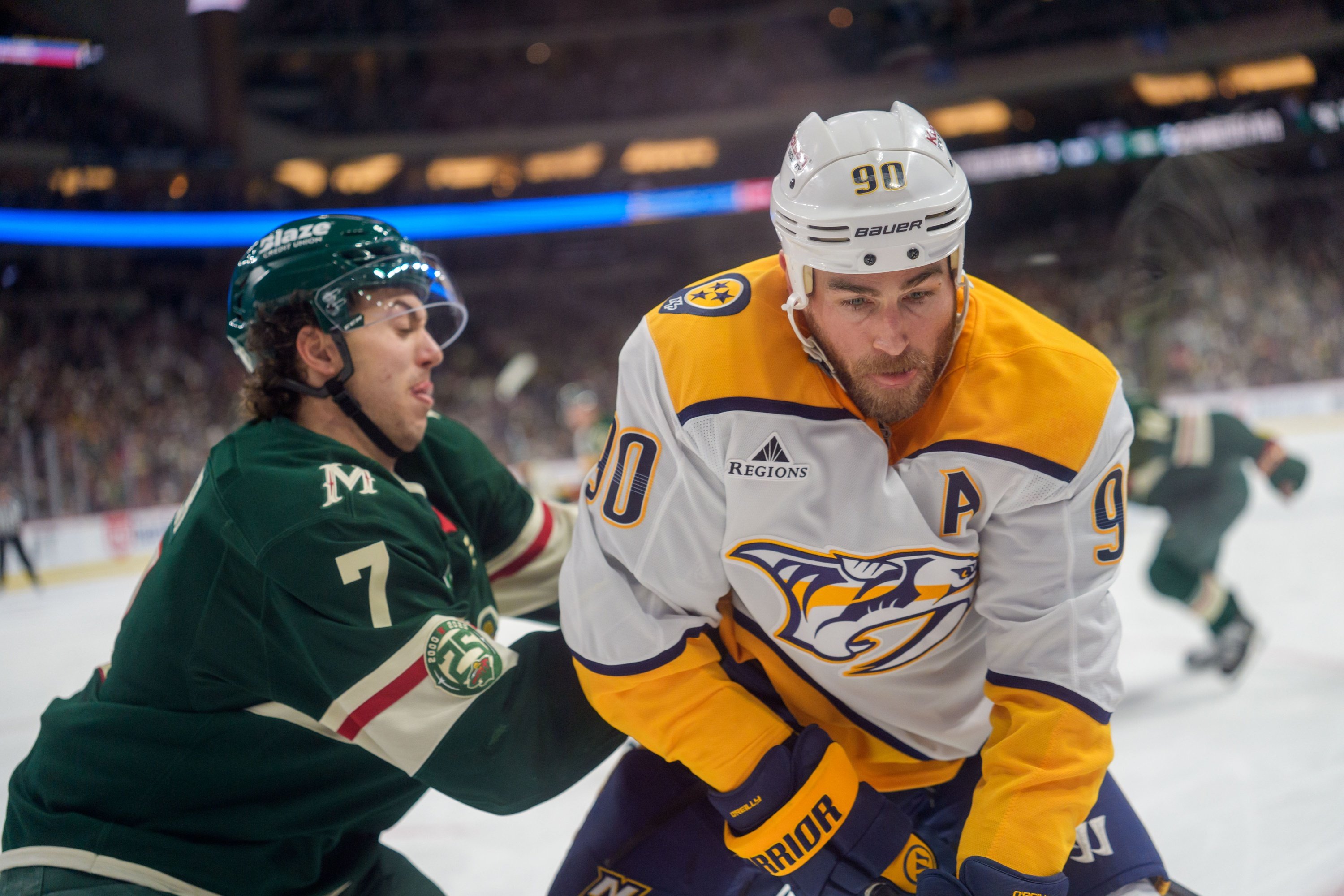
With the team still in the market for a centerman, one interesting name has recently been discussed as a possible fit for Minnesota. In The Athletic's recent piece predicting where trade targets would end up, NHL insider Pierre LeBrun forecasted Ryan O'Reilly would end up in St. Paul.
At first glance, this is a perfect fit. O'Reilly is an accomplished veteran who was a key contributor to the St. Louis Blues' Stanley Cup victory. He’s respected leaguewide and is an elite two-way center and faceoff man. He also continues to contribute offensively with 32 points in 37 games this season for a Nashville Predators team where nearly every other player is underperforming.
While he checks all the boxes for the Wild, there is one crucial potential hang-up. According to LeBrun, Pat Morris, Ryan O'Reilly's agent, has let teams know that the player isn't currently interested in a move. The reason is that O'Reilly "sees himself as part of the solution in Nashville and doesn't want to abandon ship."
O'Reilly doesn't have a no-movement clause, but Chris Johnston has reported that Nashville management respects him enough to treat him as if he did. That fact means he's in control of potential transactions.
That seems like bad news, but it actually may position Minnesota better than other teams to acquire O'Reilly's services. He clearly still wants to play a significant role on a team, something the Wild can offer him due to their lack of center depth.
For example, the Colorado Avalanche were also linked to O'Reilly in The Athletic's piece. But Colorado has Nathan MacKinnon and Brock Nelson, which would make O'Reilly the team's third-line center. That may not be enticing for a player who still wants a crucial role. On the other hand, the Wild could guarantee O'Reilly would be playing in their top six.
Let's suppose the chance for a vital spot on a team that has every other piece in place is enough to entice O'Reilly out of Nashville. What might a trade look like?
Pierre LeBrun believes the price for O'Reilly is a first-round draft pick and a top prospect. That’s a starting point, but it's also crucial to review recent comparable deals to nail down what an O’Reilly deal would look like.
There are three main trades to examine when examining a potential Ryan O'Reilly trade. The first, conveniently, is a trade involving Ryan O'Reilly.
The Toronto Maple Leafs acquired the center and Noel Acciari in 2022-23 for a playoff push. Interestingly, Minnesota was also involved in the trade as a middleman to retain salary. Toronto gave up first, second, and third-round picks along with prospect Mikhail Abramov and roster player Adam Gaudette.
Abramov ultimately never played in the NHL, so he wouldn't be considered a top prospect. This trade helps determine O'Reilly's value, since there's already been a recent market set for him. He was 31 years old then and had recently come off a Conn Smythe performance, so he carried more value than he would this year at 34, but it's a starting point.
Last season, the Colorado Avalanche acquired Brock Nelson at the trade deadline. Similar to O'Reilly, Nelson is a respected veteran known for his playoff performances and two-way play. Colorado acquired Nelson for a conditional first-round pick, William Dufour, and Calum Ritchie. Ritchie is more in line with the "top prospect" designation, with TSN ranking him as the sixth-best NHL-affiliated prospect.
The Leafs made another similar trade last year when they obtained Scott Laughton for a first-round pick and prospect Nikita Grebenkin, with the Philadelphia Flyers retaining 50% of Laughton’s salary. Grebenkin is a solid prospect who has played in Philadelphia this year but is unlikely to become a top-six player.
O’Reilly is likely worth a bit more than Laughton but a bit less than Nelson, given the Avalanche center's more consistent play in recent seasons.
Using these deals as a guide, it’s reasonable to assume the Wild would need to put together a package that is centered around a first-round pick and a prospect that falls somewhere between Calum Ritchie and Nikita Grebenkin on the spectrum of future potential.
The Wild have the draft capital. Minnesota doesn’t have its next first-round pick after trading it for Quinn Hughes, but the team still has one in 2027. While it isn’t ideal to go two straight years without a first-round pick, the Wild are in win-now mode.
The prospect part is where things get more complicated. The Wild have already emptied the cupboards for Hughes, and don’t have too many obvious top prospects.
According to Daily Faceoff's Steven Ellis, the Wild’s top five prospects coming into this season were Zeev Buium, David Jiricek, Danila Yurov, Jesper Wallstedt, and Liam Ohgren. Two of those players, Buium and Ohgren, are already gone. Wallstedt has developed into a player too essential to trade, and Nashville is already set in the net with Juuse Saros.
That leaves Yurov and Jiricek. Yurov is a good asset, but trading him for O’Reilly is a significant risk. O’Reilly would be an upgrade on Yurov, but swapping a roster center for another roster center doesn’t address the Wild’s primary issue – center depth.
Jiricek’s value is also difficult to gauge. According to Steven Ellis, the right side of Nashville’s defense is a weakness in its prospect pool. Jiricek would immediately address that. Still, he has had issues sticking in the NHL with two teams now.
It could also be tough to justify trading Jiricek for O’Reilly, given the assets Minnesota has invested in Jiricek. Trading the defender and a first-round pick would mean essentially trading two first-round picks, a second, a third, and a fourth-round pick for Ryan O’Reilly and 14 games of David Jiricek. That doesn’t feel like great asset management.
The Wild could use additional draft capital and a lower prospect, such as Adam Benak or Charlie Stramel. However, that may become an issue if a bidding war ensues for O’Reilly and the Wild can’t match other suitors’ offers.
Making two blockbuster trades in one season was never going to be easy, but the Wild have to go all-in now, and the price for O’Reilly is clear. A first-round pick and a top prospect. Minnesota can meet that price, but it will be painful. Whether it’s uncomfortable asset management or losing an important player like Yurov, there is no easy way for Minnesota to get this done.
Still, the pain of significant transactions tends to fade when a team lifts the Stanley Cup. If the Wild believe O’Reilly can accomplish that, they need to do it.
Think you could write a story like this? Hockey Wilderness wants you to develop your voice, find an audience, and we'll pay you to do it. Just fill out this form.
-
 1
1



Recommended Comments
Join the conversation
You can post now and register later. If you have an account, sign in now to post with your account.
Note: Your post will require moderator approval before it will be visible.