




By Eric Forga -
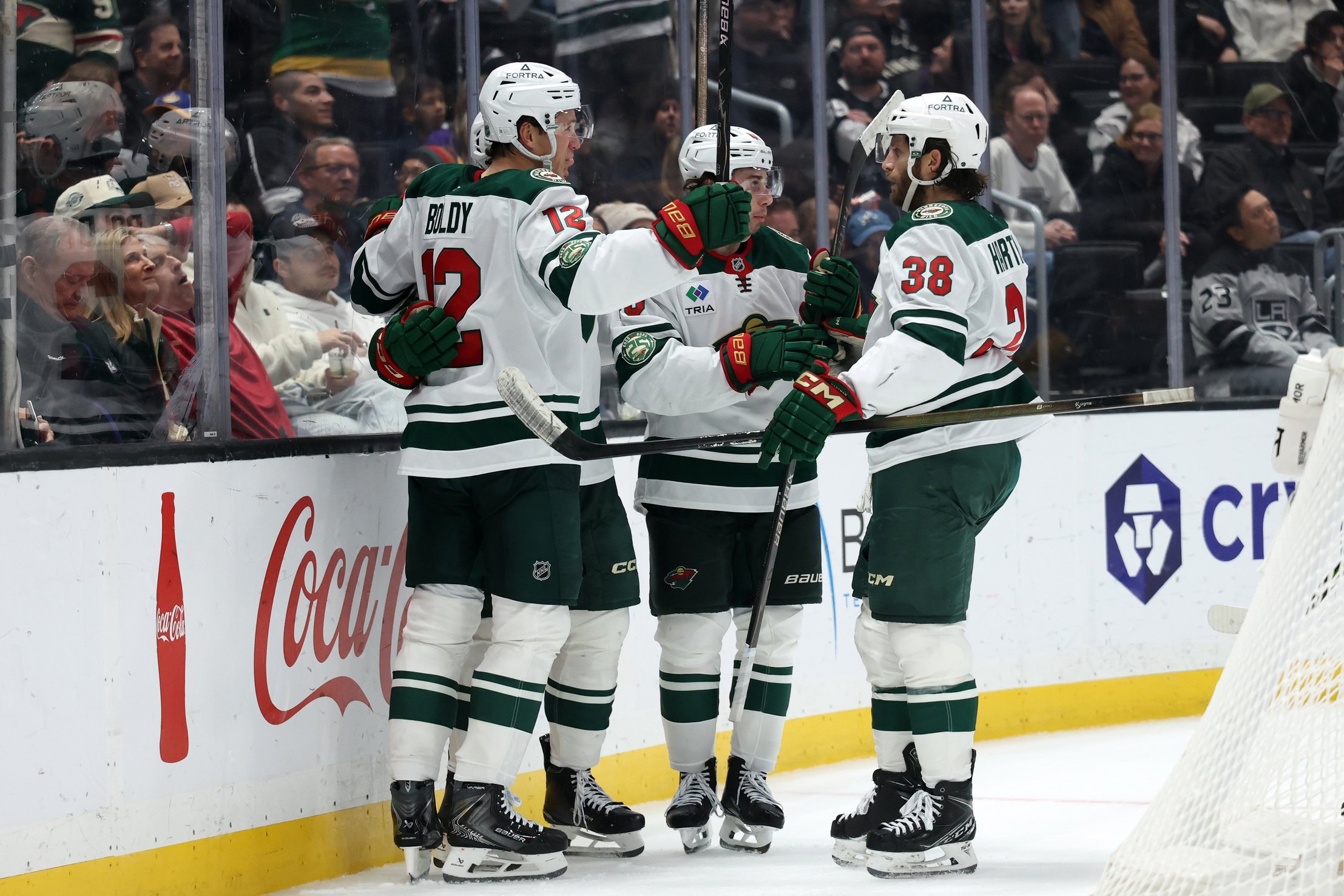
Moving Matt Boldy to first-line center would be a swing for upside that fits both his evolving game and the Wild’s roster realities. It would also create an opportunity to exploit a trade market where impact wingers are far more prevalent and simply easier to find than true top-six centers.
Framing Boldy as a 1C solution while targeting a high-end wing at the deadline could give Minnesota a more balanced, matchup-proof top six without paying the premium cost that centers usually demand.
Matt Boldy has already established himself as one of the NHL’s better young offensive wingers, consistently producing between roughly 26 and 32 goals and 64 and 75 points at five-on-five and on the power play. At 6-foot-2 with strong edges, puck protection, and vision, his toolkit looks a lot like the modern play-driving center archetype rather than a pure finisher.
There’s already evidence that the staff is willing to experiment with him down the middle. Boldy started as the first-line center against the Dallas Stars on November 16th, 2024, took 13 draws, and handled matchups before ceding some faceoffs later in the night. That look showed he can survive the responsibilities at center and hinted at upside if he gets a longer runway with consistent linemates.
Shifting Boldy to 1C would help address Minnesota’s long-running issue of high-end center depth without having to win a bidding war for an established star down the middle. A top line built around Boldy, with Kirill Kaprizov and a proven scoring winger, would distribute playmaking, finishing, and puck transport across all three spots instead of forcing Kaprizov to carry the bulk of primary creation from the flank.
Moving Boldy inside also has a cascade effect down the lineup. It allows Joel Eriksson Ek to anchor a hard-match second line in more defensive and penalty-kill heavy minutes, creating a powerful one-two punch that can tilt both shot share and expected goals in Minnesota’s favor at even strength. That kind of structure has become the standard for contenders, who almost all run at least two lines capable of driving play in tough usage.
The trade market consistently shows a clear pattern: top six capable centers are scarce and extremely expensive, while impact wingers are more available in any given deadline season. Recent trade block boards are loaded with capable, scoring wingers. And middle-six wingers with term, while the few true centers who can play in a top-six role are treated as premium assets with big acquisition prices in picks, prospects, and cap space.
For a cap-conscious team like Minnesota, that matters. Paying full freight for a 1C means sacrificing multiple futures, and often taking on serious salary, whereas landing a top-six wing rental or short-term fit usually costs less and comes with more options.
If Boldy can give you “center time” impact in-house, it’s more efficient to spend assets in the scoring wingers, where supply is deepest, and prices are competitively softer.
Reimagining Boldy as 1C allows the Wild to build a forward group that looks more like a modern contender without needing a franchise-altering trade. A plausible blueprint would be to have Boldy center the top line with Kaprizov and Zuccarello as his wings, and the second line run with Eriksson Ek, Johannson, and a top-six winger from the trade block.
Someone like Alex Tuch or Jordan Kyrou comes to mind. That combination leverages Kaprizov’s elite shot and Boldy’s play-driving down the middle, while the new winger benefits from playing alongside two savvy veterans in Ek and Johannsson. It also gives the Wild more flexibility to spread the offense around, mixing and matching to provide different offensive looks.
The bigger picture is philosophical: Using Boldy at center is a bet on internal development, while trading for a winger is a bet on market inefficiency. Minnesota can avoid overpaying for a scarce 1C, lean into Boldy’s growth curve, and still add a meaningful top-six piece from the deepest part of the deadline board.
Suppose Boldy holds his offensive impact in the middle and becomes an above-average 1C. Then, the Wild would suddenly have a legitimate high-end center solution and a more dangerous, deeper top six, all without mortgaging the future for a single expensive center acquisition.
Think you could write a story like this? Hockey Wilderness wants you to develop your voice, find an audience, and we'll pay you to do it. Just fill out this form.


Recommended Comments
Join the conversation
You can post now and register later. If you have an account, sign in now to post with your account.
Note: Your post will require moderator approval before it will be visible.