




By Neil Urbanski -
Let’s start with the positive.
Despite the Iowa Wild’s well-documented struggles in recent years, the Minnesota Wild’s roster features five young players who have spent significant time with their AHL affiliate over the past four seasons: Marco Rossi, Jesper Wallstedt, and Liam Ohgren are all currently playing key roles. Meanwhile, Daemon Hunt and recently-recalled Hunter Haight have also played games for the big club. Additionally, veterans like Tyler Pitlick and Ben Jones have done their jobs when called upon as injury replacements.
However, from a team perspective, that’s about where the positives stop. After they appeared to turn a corner in October and won two of three to start November, Iowa has dropped six straight games and plummeted to the bottom of the AHL’s Central Division with a 5-14-0-1 record through 20 games.
I watch a lot of Iowa’s games and have been taking notes on my observations as the season has unfolded. As the team passes the quarter mark of its season, it’s a good time to share updates on what’s happening in Des Moines with the team and some of its players.
If you have a question about Iowa or any of its players that I don’t address below, feel free to post it in the comment section.
No offense
The numbers are ugly: out of 32 teams, they are 31st in goals scored (37) and 28th in goals against (68). Their power play sits at a putrid 10.6% (31st) and is in the midst of a 4-for-53 stretch. The penalty kill has been mostly solid lately, but still sits at 21st in the league at 79.3%.
Gerry Mayhew leads the team with 7 goals and 3 assists in 16 games, despite not being signed until mid-October. Other than defenseman David Spacek, who also has 10 points (all assists), no other player is in double digits. Haight has produced 5 points in 14 games for Iowa, while Ohgren has had 5 in 9. Every player on the current roster has a minus rating.
Goaltending woes and a lack of chemistry
Goaltending has been a problem. In the offseason, the team brought in Cal Petersen, a veteran with 106 NHL games, to provide stability and serve as a reliable third-stringer. Still, he ranks 36th among 47 qualified AHL goaltenders with an .891 SV% over his 10 starts.
Meanwhile, Samuel Hlavaj, who came off a stellar campaign last season in which he emerged as a legitimate prospect, is dead last in the league with an .871 SV%.
The situation was so dire that the team decided to send a message and brought up William Rousseau from the Iowa Heartlanders in the ECHL to start the first game of the Grand Rapids series, a 3-2 loss in which he stopped 26 of 29 shots and played well. However, he probably wanted one of the goals back. Iowa put Petersen back in net for the second game, and he responded to the message with a solid start, stopping 28 of 29 shots in a 1-0 loss.
Interestingly, Iowa has played Grand Rapids, who is dominating the league with a 16-1 record, closer than anyone, with three one-goal losses, one of which was in a shootout. Otherwise, it’s been a real struggle. The team recently hit what it hopes was rock bottom with two 7-2 losses in a three-game stretch: one to the Toronto Marlies and the other to the Milwaukee Admirals.
The team’s struggle to find consistent lines that can develop chemistry has become apparent. Mayhew has been a fixture on the top line for a while, but the team has tried all sorts of combinations to little avail. Haight, Ohgren, Pitlick, Nicolas Aube-Kubel, and Caedan Bankier are among those who have recently played alongside Mayhew as Greg Cronin, and his coaching staff desperately try to find combinations that can fill the net.
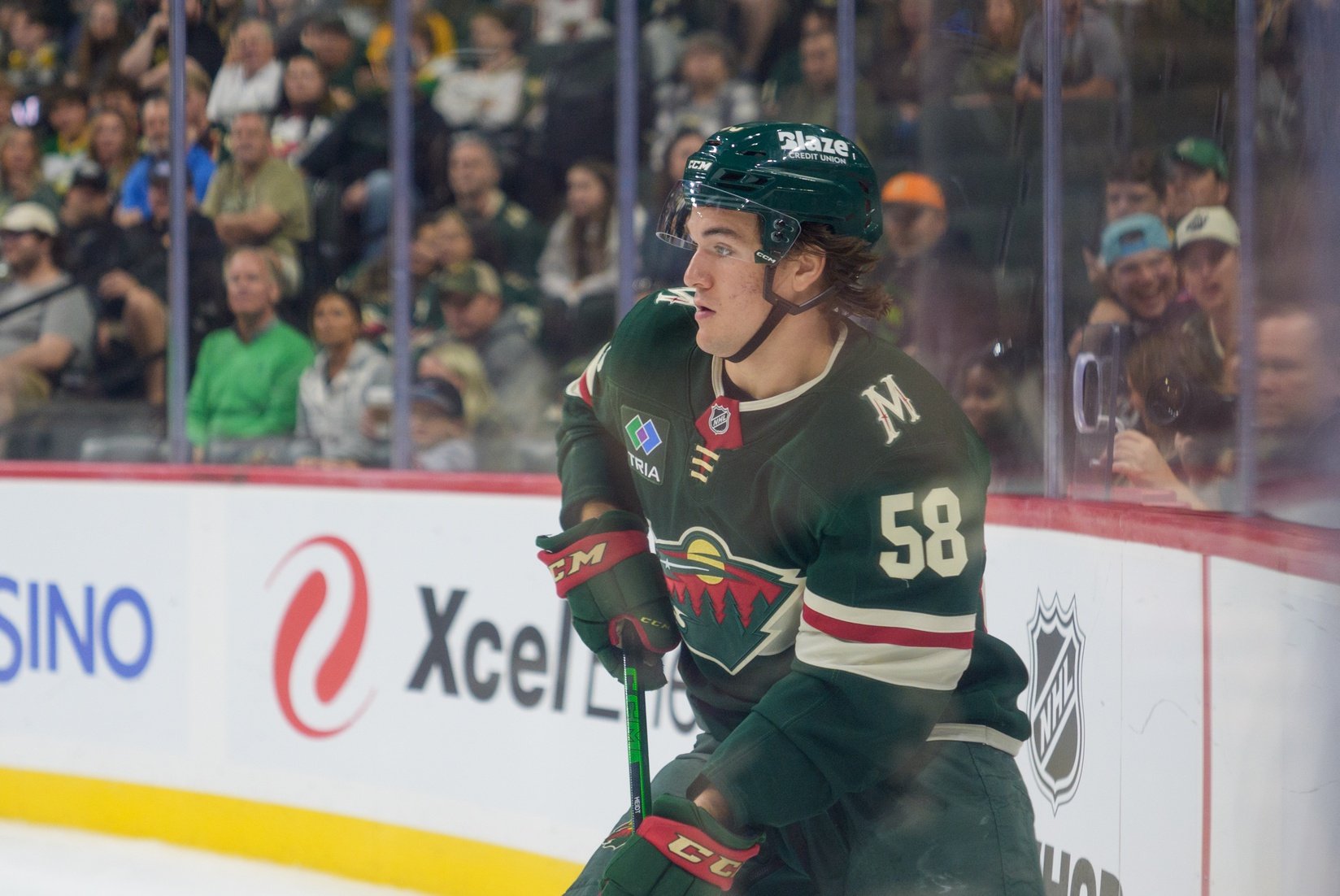
Where is Riley Heidt?
One name that fans might notice is not among those playing top-line minutes: Riley Heidt, a much-hyped prospect in his first professional season. The 20-year-old rookie from Saskatoon has had a slow start, with 2 goals and 4 assists in 19 games. He’s mostly spent time in the middle six playing both wing and center. Most recently, he has centered a new-look third line with Ryan Sandelin and Jean-Luc Foudy during Sunday’s game against Grand Rapids.
Heidt has the look of a player who lacks confidence and consistency as he learns to adapt his game to professional hockey. That’s very common among young players in the AHL, a tough, physical league with many veterans who know their roles and make life difficult for their opponents. Fans shouldn’t be concerned, but how Heidt handles adversity this year will be interesting to watch.
One of the hallmarks of Heidt’s game during his time in junior hockey and at prospect events is tenacity without the puck. When he’s at his best, he’s hounding pucks in all zones and aggressively engaging in board battles, using leverage and positioning to win pucks.
That has been notably missing for much of the season. Heidt is often hesitant to engage physically and guilty of reaching with his stick instead of fighting to get body position when contesting pucks on the wall. It’s night and day from the player that had fans and media raving about his bona fides as a prospect.
With the puck, he’s lacking the aggression and straight-line drives that he has so often used to put pressure on opposing defensemen. It’s definitely worth noting that some of his offensive struggles are probably a product of his environment.
When I wrote about Heidt after this fall’s Tom Kurvers Prospect Showcase, I noted how Heidt is “at his best when working in tandem with linemates who can read off his puck touches [and his] ability to make quick, efficient plays with the puck in all zones,” and how it would be important to find complimentary players that maximize his strengths.
So far, there hasn’t been anyone in Iowa who can fill that role, and it’s probably contributing to Heidt’s lack of confidence with the puck. For a brief time, he was on a dynamic-looking line with Rasmus Kumpulainen and Oskar Olausson. Still, as injuries and call-ups shook up the roster, that line was broken up. Kumpulainen has struggled with consistency, as has Olausson occasionally.
If I were Cronin, I might try Heidt with Mayhew, because Mayhew is an intelligent player with a track record of offensive success in the AHL. That might help jumpstart him.
Bankier is a bright spot
I’ve been back and forth with where to rate Bankier as a prospect. Last season, I wrote that he had the potential to be a valuable third-line center down the road, and earlier this season, I noted his continued improvement while also questioning whether he had the foot speed necessary to stick in the NHL.
Since then, Bankier has been one of the bright spots in Iowa, and it recently rewarded him with the opportunity to center the top line and the power-play unit in the Grand Rapids series.
Bankier is noticeable most nights because he's usually in the right spot and gets a lot of puck touches as a result. He’s got a really good release on his shot, which he can let go with power from multiple angles. It’s something he’s definitely improved at over the past year, and he’s tied with Mayhew for the team lead with 40 shots on goal.
He doesn’t have scoring touch, and he’s not quick, but he is pretty efficient with his feet and has decent straight-line speed. He makes a lot of slick area passes and works well in motion on the power play.
One of the hallmarks of his game is his stick placement when defending. He disrupts many plays and is an effective penalty killer. Another strength of his is that his game doesn’t change, no matter where he is in the lineup. He brings the same steady, two-way presence, which makes him a valuable piece.
I’ll be watching Bankier closely as the season progresses to see if he can continue to elevate his game. He’s a restricted free agent after this season, and it will be interesting to see if he gets another contract with the organization and what that might look like.
Czech mates on D
Since being sent down by Minnesota a couple of weeks back, Jiricek has been playing big minutes on the top pair and top power play unit, while also getting a lot of run on the penalty kill. That’s probably what’s needed, and while Jiricek’s stats have been underwhelming (1 goal, 1 assist, and -5 in 10 AHL games), he’s not to blame for the team’s struggles.
That said, he hasn’t been great, either. Defensively, he’s been mostly fine, but that’s never really been an issue for him. At this level, you’d like to see him making plays with the puck and using his size and length to create space. Instead, he’s been mostly vanilla when I’ve seen him, making safe plays and not really pushing the pace. Then again, maybe that’s the mandate he received from the NHL club after he displayed a propensity for bad turnovers during his time in Minnesota.
David Spacek has been impressive this season, putting up 10 assists in 19 games and taking a spot on the top power play unit. He makes good puck plays in all zones, and his efficiency with zone exits and as a distributor on offense has continued to improve. He defends well with his skating and positioning, though he can struggle on the rush at times because he doesn’t have a powerful push when accelerating backwards. He’s much improved in board battles and is clearly stronger physically this season.
There were reports last summer that Spacek might be unhappy with the opportunities he’s received in the Wild organization. While Minnesota briefly recalled him last month to serve as a seventh defenseman as the Wild dealt with injuries and illness, there doesn’t appear to be a path for him to stick in Minnesota anytime soon. He’s not a better option than anyone above him in the organization.
That said, he’s more consistent than Jiricek and is light-years ahead of Carson Lambos and Jack Peart on the organization’s depth chart. It’s starting to look like Spacek has developed towards being nearly NHL-ready. It will be interesting to see what the Wild decides to do with him.
Haight and Aube-Kubel are standouts
Haight and Aube-Kubel have been the best forwards in Iowa. They play with a pace and straight-line decisiveness that sticks out relative to their teammates. With Haight, it’s just a matter of consistency and becoming more impactful with playmaking.
His two-way game and physical play are NHL-caliber. While Haight is never going to be a goal scorer in the NHL, he can turn into a solid third-line player if he can become more of a difference maker with the puck on his stick. Aube-Kubel is a veteran who brings consistency, effort, and two-way play every night. He’s not flashy, but he’s got game and has proved to be a nice depth addition by the organization.
Think you could write a story like this? Hockey Wilderness wants you to develop your voice, find an audience, and we'll pay you to do it. Just fill out this form.
-
 6
6
-
 6
6



Recommended Comments
Join the conversation
You can post now and register later. If you have an account, sign in now to post with your account.
Note: Your post will require moderator approval before it will be visible.